Insole Arch Height: Effects on Comfort, Posture, and Foot Problems

Find the best arch support inserts for reliable foot alignment and pain relief. These orthotic insoles are engineered to improve posture, reduce fatigue, and provide stability for walking, standing, or active lifestyles.
Insole Arch Height: Effects on Comfort, Posture, and Foot Problems
Table of Contents
- Understanding Foot Arch Types and Their Importance
- How Insole Arch Height Directly Impacts Comfort
- The Critical Connection Between Arch Support and Posture
- Arch Height's Role in Preventing and Managing Foot Problems
- How to Choose the Right Arch Height for Your Insoles
- Expert Viewpoint: Biomechanics of Arch Support
- Frequently Asked Questions (FAQs)
- Conclusion
Understanding Foot Arch Types and Their Importance
The human foot arch is a marvel of biomechanical engineering, designed to distribute weight, absorb shock, and provide propulsion. It acts as a natural spring, and its height varies significantly among individuals. Broadly, arch types are categorized into three main groups:
The Three Primary Arch Types
1. Low Arch (Flat Feet)
Characterized by minimal curvature, often with the entire sole making contact with the ground. This can lead to overpronation, where the ankle rolls inward excessively during movement.
2. Neutral (Normal) Arch
The ideal arch height, providing a balanced distribution of weight and efficient shock absorption. It offers a natural alignment for the foot and ankle.
3. High Arch (Pes Cavus)
Features a pronounced, rigid curvature with limited ground contact. This often leads to underpronation (supination), concentrating pressure on the heel and forefoot.
Selecting an insole with the correct arch height is not merely about comfort; it is about restoring or maintaining the foot's natural function and alignment.
How Insole Arch Height Directly Impacts Comfort
Comfort in footwear is fundamentally linked to proper support. An incorrectly sized arch in an insole can create pressure points or fail to support key structures, leading to immediate and chronic discomfort.
Mechanisms of Discomfort and Relief
For Low Arches:
Without adequate arch support, flat feet can strain the plantar fascia ligament and collapse inward, causing arch and heel pain. A low to medium profile arch insole helps cradle the arch, reducing tension on soft tissues.
For High Arches:
The lack of a sufficient contact area concentrates force. A higher, cushioned arch fill helps distribute this pressure more evenly and provides necessary shock absorption that the rigid foot cannot.
Universal, flat insoles often neglect these nuances, while contoured arch supports actively mold to and support the foot's unique topography, eliminating empty space and providing all-day comfort.
The Critical Connection Between Arch Support and Posture
The foundation of your entire body's alignment begins at your feet. This concept, known as the kinetic chain, means that misalignment at the foot can cascade upwards.
From the Ground Up: The Kinetic Chain Effect
An unsupported low arch (overpronation) causes the tibia and femur to rotate internally, potentially leading to:
- Knee valgus (knock-knees)
- Anterior pelvic tilt
- Lower back strain
Conversely, a high arch (underpronation) creates a less stable base, forcing the body to compensate, often resulting in tight calf muscles and increased stress on the outer leg and hip.
Insoles with targeted arch height correct these deviations at the source, promoting neutral ankle alignment. This, in turn, helps align the knees, hips, and spine, improving overall postural integrity and reducing fatigue in the back and joints.
Arch Height's Role in Preventing and Managing Foot Problems
Chronic foot conditions are frequently tied to improper arch mechanics. Correct insole arch height serves as a primary line of defense and a key component of treatment.
Specific Conditions and Arch Support Solutions
Plantar Fasciitis:
Often linked to both flat feet and high arches. Supportive insoles with appropriate arch contouring reduce tension on the plantar fascia ligament, especially with a medial arch support for overpronators.
Metatarsalgia (Forefoot Pain):
High arches can increase pressure on the ball of the foot. Insoles with a high arch and a metatarsal pad help redistribute this pressure.
Post-Tibial Tendonitis:
Common in overpronators. Insoles with firm arch support stabilize the heel and offload the stressed tendon.
By ensuring even weight distribution and proper alignment, the right arch height can prevent the development of calluses, bunions, and stress fractures associated with biomechanical flaws.
How to Choose the Right Arch Height for Your Insoles
Selecting the correct arch height is a personalized process. Here is a practical guide:
Step 1: Determine Your Arch Type
Perform the wet test: Wet your foot and step onto a paper bag or cardboard. Match the imprint to the three arch types: full imprint (low), curved imprint with connecting band (neutral), or very narrow connecting band (high).
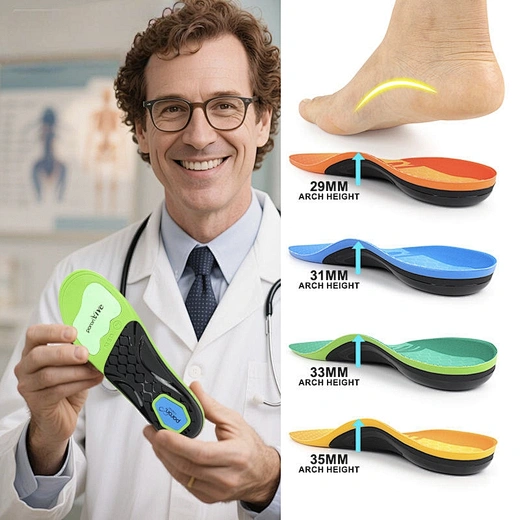
Step 2: Understand Insole Arch Profiles
- Low Profile: Gentle support, ideal for flat feet or beginners to orthotics.
- Medium Profile: Versatile support for neutral to moderately low/high arches.
- High Profile: Pronounced support for definite high arches or severe overpronation.
Step 3: Consider Material and Adjustability
Firmer materials (like semi-rigid polypropylene) offer more structural support for correction, while softer foams provide cushioning. Some insoles feature heat-moldable arches for a custom fit.
When in doubt, consult a podiatrist or a specialist at a running store for a professional gait analysis.
If you're looking to alleviate foot fatigue, improve alignment, or simply enhance everyday comfort, investing in the right arch support insoles can be a game-changer. Not all feet are created equal, and thankfully, neither are insoles. Here’s a look at four key types designed to meet specific needs:
For those new to arch support or with mild discomfort, lightly cushioned support insoles offer a perfect introduction. They provide a gentle lift and foundational stability, ideal for daily wear in standard footwear without feeling overly intrusive. Think of them as a comfortable "boost" that helps distribute pressure more evenly.
Individuals with pronounced, high arches often experience excessive pressure on the heels and balls of the feet. High-arch-specific insoles are contoured to match this unique structure, offering deeper, firmer support to fill the gap and promote better weight distribution. This can help reduce strain and prevent common issues like shin splints or plantar fasciitis.
Why settle for a one-size-fits-all approach? Adjustable multi-height support insoles come with interchangeable pads or modular components that allow you to customize the arch height. This versatility is perfect for finding your personal "sweet spot" of support, accommodating changes throughout the day or as your needs evolve.
For the ultimate personalized fit, heat-moldable custom insoles are the pinnacle of foot care. Using body heat or a warm oven, these insoles soften and can be molded precisely to the contours of your feet. Once cooled, they retain this custom shape, providing targeted support that addresses your unique biomechanics, making them an excellent solution for persistent pain or unusual foot shapes.
Finding the right support is a step toward happier, healthier feet. Consider your arch type, activity level, and specific discomforts to choose the insole that best supports your journey.


Expert Viewpoint: Biomechanics of Arch Support
Dr. Anya Sharma, a Doctor of Podiatric Medicine and biomechanics researcher, emphasizes the functional role of insoles:
"The goal of an insole is not to permanently hold the arch in a passive position, but to facilitate its natural, dynamic motion. An optimally contoured arch support acts as a fulcrum, allowing the arch to lengthen and recoil efficiently with each step. This enhances the windlass mechanism—a critical function for propulsion. Choosing the wrong arch height can inhibit this mechanism, leading to compensatory patterns and injury. It's about providing the right amount of support at the right phase of the gait cycle."
Dr. Sharma advises that effective insoles work in concert with the foot's musculature, not as a substitute for it, and should be paired with appropriate strengthening exercises.
Frequently Asked Questions (FAQs)
1. Can wearing insoles with the wrong arch height make my feet weaker?
If insoles are overly rigid and corrective without a strengthening regimen, they can potentially lead to muscle disuse over a very long period. However, for most people with pain or dysfunction, appropriately prescribed insoles reduce strain and allow for proper function, which can actually improve foot health. The key is balanced support and active exercise.
2. I have one flat foot and one normal arch. What should I do?
This is not uncommon. The best solution is to use different insoles for each foot or opt for custom orthotics that are molded specifically for each foot's unique architecture. Using a one-size-fits-all insole will over-support one foot and under-support the other.
3. How long does it take to adjust to new insoles with proper arch height?
An adaptation period of 1-2 weeks is normal. Start by wearing them for 2-3 hours a day, gradually increasing usage. Some initial mild discomfort is common as your body adjusts to the new alignment, but sharp pain indicates the arch height or type may be incorrect.
4. Are expensive custom orthotics always better than over-the-counter insoles?
Not always. For complex biomechanical issues, severe deformities, or specific medical conditions, custom orthotics are unparalleled. However, many high-quality, over-the-counter insoles with multiple arch height options can effectively manage common problems like mild overpronation, plantar fasciitis, or general fatigue. The best choice depends on the severity of your needs.
5. Can children benefit from arch support insoles?
Yes, but with caution. Children's feet are developing, and excessive, rigid arch support is generally not recommended unless prescribed for a specific condition (e.g., severe flat feet causing pain). For most children, flexible, supportive footwear is sufficient. Always consult a pediatric podiatrist first.
Conclusion
The height of the arch in your insoles is a pivotal factor that extends its influence far beyond your feet. It is a critical determinant of all-day comfort, a cornerstone of proper postural alignment, and a powerful tool for both preventing and managing a wide array of common foot problems. From alleviating the strain of plantar fasciitis to improving the efficiency of your gait, selecting the correct arch height is an investment in your foundational health. By understanding your arch type, respecting the biomechanical principles at play, and heeding expert advice, you can make an informed choice that supports every step you take, promoting long-term mobility and well-being.


Flat Feet and High Arches: Causes, Risk Factors, and Management Strategies
7 Signs You Need Supportive Insoles for Better Foot Health