The Science of Shock Absorption: How Sports Insoles Protect Your Joints
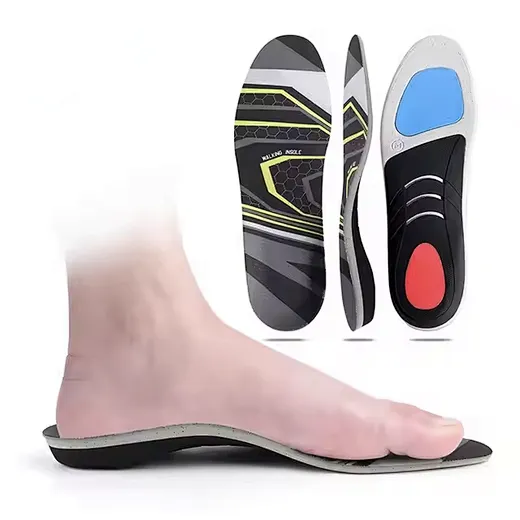
Support flat feet during activity with specialized flat feet sports insoles. Our orthotic design provides arch support, stability, and shock absorption for running, basketball, and training.Reduce overpronation and foot fatigue while maintaining comfort.
The Science of Shock Absorption: How Sports Insoles Protect Your Joints
Table of Contents
Introduction: The Hidden Cost of Every Step
Each time your foot strikes the ground during a run, your body endures a force equivalent to two to three times your body weight. Without proper mitigation, this repetitive shock travels up through your ankles, knees, hips, and lower back, gradually wearing down cartilage and increasing injury risk. The science of shock absorption is not merely about comfort—it’s a physiological necessity. At the heart of this protection lies an often-underestimated tool: sports insoles. These engineered inserts are designed to dissipate impact forces, stabilize the foot, and safeguard your joints over thousands of strides.
The Biomechanics of Impact: What Happens When You Land
To understand how insoles protect, we must first explore the gait cycle. During heel strike, the impact generates a shock wave that passes through the calcaneus (heel bone) up the kinetic chain. Ideally, the foot’s natural pronation helps absorb some energy, but excessive force leads to micro-trauma. Research published in the Journal of Applied Biomechanics shows that inadequate shock absorption can increase joint load by up to 20%, accelerating conditions like osteoarthritis. This is where sports insoles intervene: by altering the deceleration rate of the foot, they reduce the peak force transmitted to the joints.
The Role of the Plantar Fascia and Fat Pad
The foot’s own fat pad provides natural cushioning, but it thins with age and repeated stress. High-quality insoles supplement this biological system, acting as an artificial fat pad that maintains elastic energy return and minimizes bone-on-bone vibration.
The Physics of Shock Absorption: Energy Dissipation 101
Shock absorption is governed by the laws of physics: kinetic energy (from movement) must be converted into another form to reduce impact. Insoles achieve this through:
1. Compression and Deformation
Materials like viscoelastic foam or gel compress under load, spreading the force over a longer time period (impulse = force × time). By increasing the time over which force is applied, the peak magnitude drops significantly.
2. Hysteresis (Energy Return)
Some insoles use rebound materials that return a portion of energy to propel forward motion, reducing muscular effort. However, for joint protection, the priority is energy dissipation—turning mechanical energy into small amounts of heat, which prevents it from reaching the skeleton.
3. Force Redistribution
Insoles with metatarsal pads or arch contours spread load across a wider area, lowering pressure points. According to Pascal’s principle, distributing force over a larger area reduces localized stress—critical for joints like the knee, which are sensitive to uneven loading.
Materials Science: What Makes a Sports Insole Effective?
Modern sports insoles are marvels of material engineering, often combining multiple layers for tailored performance.
Polyurethane (PU) Foam
PU foam is prized for its durability and slow rebound, making it excellent for absorbing high impacts. It compresses progressively, ideal for runners with heavier strides.
Ethylene-Vinyl Acetate (EVA)
EVA is lightweight and offers good cushioning, though it tends to pack out over time. High-grade EVA with closed cells retains its shock-absorbing properties longer.
Viscoelastic Gel
Silicone or proprietary gel inserts excel at shear force reduction—they move laterally to reduce friction blisters while absorbing vertical shock. Often placed in the heel or forefoot strike zones.
Carbon Fiber Plates
Some advanced insoles integrate carbon fiber layers to provide torsional rigidity, ensuring that shock absorption doesn’t come at the cost of stability. This combination protects joints without compromising propulsion.
Additive Manufacturing (3D Printed Insoles)
Emerging technologies now allow lattice structures tuned to an individual’s weight and strike pattern, offering unprecedented customization of shock absorption zones.
Here is a closer look at three innovative insoles we’re featuring, each engineered with advanced materials to solve specific foot comfort needs:
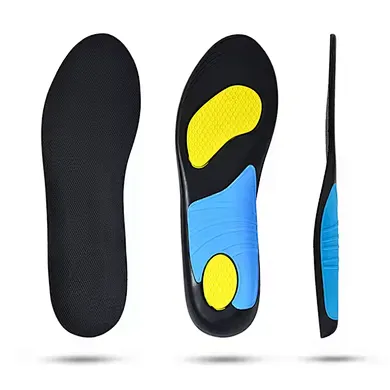
1. The All-Rounder: EVA + TPU + GEL
This insole is built for versatility and high-impact activities. It features a layered construction that starts with a sturdy EVA (Ethylene-Vinyl Acetate) foam base for lightweight, long-lasting cushioning. Integrated into the midfoot is a TPU (Thermoplastic Polyurethane) support chassis, which locks the foot in place and prevents overpronation by stabilizing the arch. To complete the package, targeted GEL pods are strategically placed in the heel and forefoot to actively absorb and dissipate the shock of every step, making it ideal for runners and those who spend long hours on their feet.
2. The Performance Enhancer: PU + Carbon Fiber
Designed for the athlete who demands maximum responsiveness, this insole prioritizes a low-profile fit without sacrificing support. It is crafted from a high-density PU (Polyurethane) foam that offers excellent energy return, meaning it helps propel your foot forward with each stride. The standout feature, however, is the embedded carbon fiber plate. This rigid yet lightweight material provides exceptional torsional stability and arch support, ensuring your foot remains stable during quick cuts and sprints, all while maintaining a sleek, non-bulky profile inside your performance shoes.
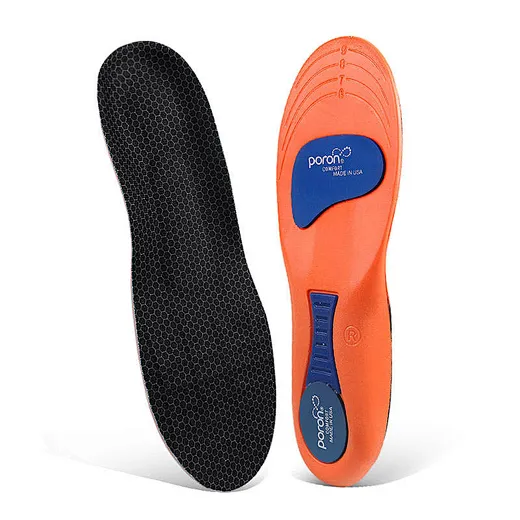
3. The Therapeutic Choice: PU + Poron®
If comfort and pain relief are your primary goals, this insole is the ultimate solution. The base is made from a plush PU foam that conforms to the unique contours of your foot, offering a custom-like feel. The key differentiator here is the integration of Poron®, a high-performance urethane foam known for its superior, long-lasting cushioning and shock absorption. This Poron® layer, often placed in the heel strike zone, does not pack down over time, ensuring consistent protection against impact. This targeted cushioning is clinically shown to reduce the stress on the plantar fascia, making this insole a top recommendation for anyone suffering from plantar fasciitis or looking for premium, all-day comfort.


How Sports Insoles Protect Specific Joints
The protective benefits cascade upward from the foot.
Ankles: Stabilizing the First Link
Insoles with a deep heel cup and medial/lateral support reduce excessive inversion/eversion, preventing ankle sprains. By controlling pronation, they ensure the talus bone aligns correctly with the tibia, reducing shear in the ankle joint.
Knees: The Primary Beneficiaries
The knee is particularly vulnerable to rotational forces. Sports insoles that correct overpronation align the patellofemoral pathway, reducing stress on the anterior cruciate ligament (ACL) and menisci. A 2021 study in Medicine & Science in Sports & Exercise found that runners using custom orthotics reduced knee adduction moments by 12%, lowering osteoarthritis risk.
Hips and Lower Back
Shock that bypasses the knee travels to the hip joint and lumbar spine. Insoles with adequate heel cushioning dampen the vertical shock before it reaches the sacroiliac joint. Many athletes report reduced lower back pain after switching to high-shock-absorbing insoles.
Expert Insights: What Podiatrists and Biomechanists Say
“We often forget that the foot is the foundation. If the foundation isn’t absorbing shock properly, every structure above compensates—sometimes to its detriment. Sports insoles are not just ‘cushioning’; they are a biomechanical tuning tool. I recommend insoles with dual-density foam for patients who have early joint degeneration because they provide both impact attenuation and proprioceptive feedback—the brain gets better signals to adjust muscle firing patterns.”
— Dr. Elena Márquez, DPM, Fellow of the American College of Foot and Ankle Orthopedics
“From a material science perspective, the future is in adaptive shock absorption. Imagine insoles that stiffen on high-impact activities but remain soft during walking. We’re already seeing prototypes with magnetorheological fluids. But even today, a well-engineered EVA/gel combo can reduce peak tibial acceleration by 30%—that’s a game-changer for joint longevity.”
— Dr. Kenji Tanaka, PhD in Sports Engineering, University of Tsukuba
Choosing the Right Sports Insole: Matching Science to Your Sport
Not all insoles are equal; selecting one depends on your primary activity.
For Running (High Vertical Loads)
Look for heel gel pads and forefoot cushioning. A thicker insole (5-8mm) with gradual slope change works best.
For Court Sports (Basketball, Tennis)
Lateral stability is key. Choose insoles with reinforced arch support and shock-absorbing foam that also resists compression during quick cuts.
For Hiking (Long Duration, Varied Terrain)
Prioritize moisture-wicking layers and high-energy return materials to reduce foot fatigue over miles. Closed-cell polyurethane retains shock absorption even when wet.
Custom vs. Over-the-Counter
While custom insoles are tailored to your foot, many OTC options now offer excellent shock absorption thanks to advanced moldable foams. Ensure they have a firm midsole layer for durability.
Industry Frequently Asked Questions (FAQ)
Q1: Can sports insoles completely eliminate joint pain?
No insole can “cure” underlying conditions, but high-quality shock-absorbing insoles significantly reduce symptomatic pain by lowering joint loads. They are a preventive and supportive tool, not a medical cure.
Q2: How often should I replace sports insoles for optimal shock absorption?
Most insoles lose 30-50% of their shock-absorbing capacity after 300-500 miles (or 6 months of regular use). Foam compression leads to diminished returns. Replace them when you notice increased fatigue or visible flattening.
Q3: Do expensive insoles absorb shock better than cheap ones?
Not always, but premium insoles often use multi-density foams and targeted gel zones that cheaper ones lack. However, a moderately priced insole with proper heel cup and arch support can outperform a poorly designed expensive one. Check for independent lab test data.
Q4: Are gel insoles the best for shock absorption?
Gel is excellent for immediate softness, but it may not provide enough stability for high-impact sports. Combination insoles (gel + foam + supportive base) usually offer the best of both worlds: initial comfort plus long-term structural support.
Q5: Can I use sports insoles in non-athletic shoes for daily joint protection?
Absolutely. Many people benefit from wearing mild shock-absorbing insoles in work or casual shoes, especially if they stand all day. This reduces cumulative microtrauma to knees and hips even during walking.
Q6: Do insoles affect running economy?
Initially, some runners feel a slight change, but once adapted, proper insoles improve efficiency by aligning the skeleton and reducing wasteful muscle activation caused by instability. The net effect is often positive for endurance.
Conclusion: Step Smarter, Protect Longer
The science is clear: every step sends a shockwave through your body, but with the right intervention, that impact can be managed. Sports insoles are a scientifically validated tool to attenuate force, stabilize joints, and extend the healthy life of your knees, hips, and spine. By combining principles of physics, advanced materials, and biomechanical design, modern insoles transform how your body interacts with the ground. Whether you’re an elite athlete or a weekend warrior, investing in quality shock-absorbing insoles is an investment in your long-term mobility. As Dr. Márquez reminds us, “Protecting the joint starts from the ground up.” Choose wisely, replace regularly, and let science support every stride.


Run Faster, Hurt Less: The Best Running Insoles for Marathon Training
The Science of Shock Absorption: How Sports Insoles Protect Your Joints